Showing posts with label Cyber Crime. Show all posts

Sunday, October 2, 2011

Suit Claims Real Estate Firm Hacked Rival’s Listings

From the Wall Street Journal,

Bond New York, a real estate brokerage with hundreds of upscale apartment listings around the city, has been accused of hacking into a competitor’s computer system and stealing listing information.

A.C. Lawrence & Co., a competitor firm, has filed suit in New York Civil Supreme Court, claiming that Bond has been hacking into its computer system since February and stealing exclusive listing information.

Competition among residential brokers for exclusive listings has long been fierce, the suit notes that this appear to be the first time in New York State that a brokerage has been accused of hacking into computers to steal listings.


Continue reading here

Sunday, September 25, 2011

Coordinated ATM Heist Nets Thieves $13M

Courtesty of Brian Krebs of KrebsOnSecurity.com,

An international cybercrime gang stole $13 million from a Florida-based financial institution earlier this year, by executing a highly-coordinated heist in which thieves used ATMs around the globe to cash out stolen prepaid debit cards, KrebsOnSecurity has learned.

Jacksonville based Fidelity National Information Services Inc. (FIS) bills itself as the world’s largest processor of prepaid debit cards; FIS claims to process more than 775 million transactions annually. The company disclosed the breach in its first quarter earnings statement issued May 3, 2011. But details of the attack remained shrouded in secrecy as the FBI and forensic investigators probed one of the biggest and most complex banking heists of its kind.


Read more here.

Monday, December 6, 2010

Cybergang infects all ATMs in Russian city

from help net security ...

A group of fraudsters has been arrested in Yakutsk and Moscow for allegedly compromising all the ATMs in the city of Yakutsk - population: around 210,000 - in the Republic of Yakutia in the Russian Federation.

Three of the men formed the actual criminal group, and the fourth - a Moscow-based malware developer - was "subcontracted" by them and received 100,000 rubles (some $3200) to develop a a custom ATM virus with which they would infect the devices.

Every man had his role in the operation: one who used to work as a head of an IT department obtained access to the ATMs, the second one - a system administrator - infected them, and the third one was supposedly intended to be the money mule.

According to the press release (Google translation) issued by the Ministry of Internal Affairs' cybercrime division, a coordinated raid of the three's apartments led to their arrest and the confiscation of copies of the malware and credit card information that - according to the investigators - they didn't have time to take advantage of.

The malware author was arrested in Moscow a week after. All four have been detained and will likely be charged for creation, use and distribution of malicious computer programs, and hopefully fraud.


this is not good .....

Monday, November 15, 2010

Anatomy Of An Attempted Malware Scam

I stumbled across this fascinating inside account of how cyber criminals infiltrate online advertising by Julia Casale-Amorim of Castle Media. Try not to get lost in the technical jargon of the advertising world and instead focus on the criminal's cleverness and level of effort.

The display media segment is the newest target of malvertising, the latest trend in online criminal methodology. The problem has escalated in recent months and despite many suppliers' best efforts, it continues to grow. The culprits behind many of these attacks are based in foreign states leaving little course to take action. While the best defense against malvertising is to prevent it from happening in the first place, this has proven to be a challenge for even the most astute publishers, networks and the like.

We were recently the targets of one such attempt, and while it certainly wasn't the first "fake agency" we've been besieged by (and that we've successfully stopped), it is one of the most organized efforts we've encountered so far. Below we've outlined the approach that was used and the findings of our investigation as an FYI to others who may be on the target list.

If there's anything we've learned since the practice of malvertising has surfaced (and has since proliferated), it's that you can't be too detailed with your client background checks and creative reviews. We've always been big on our screening procedures, and these days it's proving to be an increasingly valuable practice. Malvertising reflects negatively on the entire online media industry and the onus has to fall on us (suppliers) to put a stop to it. So, we want to share our learnings here for the greater community to hopefully benefit from.

Here is a breakdown of the approach used by the individuals behind our most recent malware experience, how we caught them, and the findings of our subsequent investigation. We've also highlighted some pink flags (and the ultimate red flag) that came up along the way, as well as our key takeaways from the experience including some of the steps we now have in place (and which you may want to consider implementing) to help us identify similar perpetrators sooner than later.

Initial contact, proposal and campaign review

The culprits approached us in early July representing themselves as an agency looking to place a campaign for both a big name charity and a travel client (we are omitting names to protect their brands from being associated with this scam. We have no reason to believe they were involved). Following our proposal phase, "Bellas," informed us that the big name charity was still "undergoing approval phase", but that their travel client had approved a test on our network and wanted to proceed.

(Pink flag: while not completely implausible, it is rare for an unknown agency to bring one or more large brands to the table, let alone doing so without first undergoing a formal RFI/RFP process.)

Despite the pink flag, we proceeded, and because we had never worked with this agency before, we began by processing their request for credit. Each of the references provided had professionally produced websites and unique phone numbers -- nothing at the surface level that would raise any suspicion. The bank reference was real (a real bank, that is) and the phone number provided worked. The information we requested was supplied to us in an official, expected manner. Nothing out of the ordinary here.

All three references we contacted provided prompt and friendly responses and each reported that they had been doing business with Bellas for anywhere between two years and six months at fairly respectable sums.

For added assurance, the "fake agency" supplied us with a PDF which was represented as an official document of incorporation.

With no glaring reason to deny, we approved their application for limited starter credit and proceeded to the next step, campaign setup.

Campaign Setup and QA

The campaign's goals were a little unusual for what we would typically consider to be a direct response advertiser:

We are really focused on reach and unique viewers optimizations. Thus tight frequency cap like 1/24 or 1/48 can work. CTR is secondary goal at this point. A lot of people don't know much about client services and we want to cover every single possible customer.

We logged their goals and rationale. We also noted them as a pink flag. The proprietors of these scams typically focus more on unique reach and frequency than on targeting, audience or optimization - a focus that, in general terms, is most unusual for the average online advertiser. Of course, in hindsight, their interest in unique reach stemmed from their desire to infect across the widest possible net.

On our initial request for creative, "Bellas" provided us with a set of third-party tags, which were rejected because they were not from one of our certified ad serving vendors.

We were then provided with raw creative files. While the creative were clean (i.e. no malicious code), there were some minor design flaws including missing borders and file sizes that exceed our standard maximums. We informed them of these issues and they responded:

We are currently run[ning] with AOL and Yahoo (including comscore 1-150 pubs) and they are cool.

Hum, really? AOL and Yahoo have some of the strictest ad specs around...(pink flag).

After some lengthy back and forth about the creative revisions...

We are not able to reduce creative size without sacrificing quality. If you cannot run creative size more than 20kb -- we can host. If not -- we wont be able to proceed with campaign.

"Bellas," at that point, requested that we run an impression tracking URL. The "OpenX" URL provided to us was flagged during our QA review, another pink flag; the formatting and characters were not consistent with the standard employed by OpenX. We informed Bellas that to use the URL we would need to perform a few modifications to make it consistent with the standard. We provided an example of the modified URL and then received the following responses:

I have contacted OpenX support to find out. Meanwhile I got another pixel for you. We have used it with our hosted campaigns and it worked wonders.

Client prefers Eyeblaster tracking URL (their ad server). Would be cool if you can implement. If not -- OpenX is perfectly fine.

Next, Bellas, informed us of the "response" they received from "OpenX support" and then supplied us with a new pixel to use.

"Hi Henry. Looks like Casale runs , which is NOSCRIPT part of the code, instead of JS pixel (script part), that affects reporting a bit and you cannot add any additional tracking code." Are you able to implement JS OpenX pixel or Eyeblaster pixel directly? Alternatively, we can provide tags.

After informing "Bellas" that we would forward the new pixel to our traffic team for evaluation, we received the following response...

Client have sent another pixel, from zedo.

Pink flag. So now we have a client who wanted to serve through OpenX, then Eyeblaster, and now Zedo? Really? We reviewed the Zedo tracking URL and asked for confirmation about a few details since it did not conform to the ad server's standard. They replied,

For JS pixel to work properly, you need to load is exactly like that ... Will work.

Red flag! The set of tags provided were imitation tags. We ended discussions with the client at this point since things were just not adding up, and launched a detailed investigation to confirm our suspicions.

During our investigation we discovered the phone number provided in the credit application was not a legit phone number for the bank. We also learned that the domains of each of the references provided were registered within two days of each other... and that the registrations took place only days before Bellas Interactive's request for credit was issued - despite the fact that the references "claimed" to be working with Bellas across a 6-24 month spread. And finally, the Bellas Interactive website claimed to be in operation since 1994, despite the fact that the domain was registered in April of this year.

In Summary

Entities like this are cunning and smart. Their scams are well thought through and executed. The best defence against them is rigorous proactive screening. You have to be really, really astute. Question everything. These guys know the industry lingo, procedures and have created a false environment designed specifically to validate their non-existence. Even the most insignificant detail can be a huge clue.

Our Lessons Learned and Advice for Others

Perform independent fact checking.
Don't take the information provided to you on bank/credit reference applications at face value. Perform a few spot checks to validate the sources. If, when we looked up the bank reference, we had cross referenced the phone number provided by Bellas with the numbers listed on the bank's website, we would have exposed a major crack in their armour upfront, which would have saved us a lot of wasted time and effort.

Research. Then research some more.
Make it SOP to do research on not only the agency in question, but the credit references provided to you. Search for them online, do a WHOIS lookup on the domains, ask around. Make certain that everything adds up. You can't be too cautious.

When the going gets tough...
If a client is difficult to work with, there's probably a reason for it. Standards exist for a reason. Any account that is operating outside the norms should register as an immediate red flag to you. Issues surrounding pixels, creative design, obsession over going live too quickly with no sound rational or justification...any of these examples should set alarm bells off in your head!
Be suspicious.

Perception is selective. It's natural for small details to escape us when we're not on guard or actively looking for something. It's also easy to get overly comfortable with the mechanics of a standard procedure. If you approach every new account with suspicion, you'll be far more aware of any detail that may seem out of place.

Don't assume. Question and verify.
Certify third party ad servers that you are willing to deliver through, and keep clear lines of communication open with them at all times. Store tag templates and use them in your QA/review process. If a tag deviates from the standard template that you typically see from a third party ad server, escalate to them for an opinion. Never assume that the template has changed, always question it.

Re-examine critical points in your new account process.
When an account is new, consider minimizing the involvement of your sales staff in the review and verification process. In some cases, a sales person's thirst for new revenue can hamper their nose for suspicious behavior.

Sunday, November 14, 2010

USAA Credential Phishing

Security company M86 blogs about a sophisticated phishing attack targeting members of the USAA. Would you have spotted this attack?

Today we started seeing a new phishing campaign which is being sent by the Cutwail spambot, targeting customers of the United States Automobile Association (USAA). Cutwail is the spamming component installed by the Pushdo botnet. The phishing emails ask the recipient to fill out a ‘confirmation form’ which they can access by clicking on a link in the message.


To hide the URL of the phishing web page, these emails contain a link to one of several different URL shortening services such as http://bit.ly which redirect the browser to the actual phishing page.

The link ‘Access USAA Confirmation Form’ in the spam email above points to http://bit . ly/agWGNG. When we tested this link, bit.ly had already determined that there may be a problem with the URL it was redirecting to and displayed a warning page rather than redirecting us to the phishing page.

If we choose to ignore this warning and continue to the un-shortened URL, we end up at the page below, a phishing website aimed at stealing information from USAA members. This page, titled ‘Cardholder Form’, asks the user to provide information such as their online ID, password, name, card number, card security code and PIN. When the user clicks the submit button all of the details are sent to the criminals’ server and the users’ browser is redirected to the real USAA website.


For now, this phishing site, which is hosted on the domain vsdfile (dot) ru is not serving up any malicious content. The USAA provides a banking and credit card service which may be the intended target of these criminals once they have tricked a customer into divulging their cardholder details.

We have not seen one of these large scale phishing campaigns from Cutwail for some time, as the cybercriminals switched to spamming out links to the data-stealing Zeus malware. With the recent high profile arrests of several Zeus perpetrators, and all the subsequent public attention on Zeus, maybe phishing, where you politely ask for data instead of stealing it, will come back in fashion
?

Mapping Attacks Against Online Banks

From Krebsonsecurity.com ...

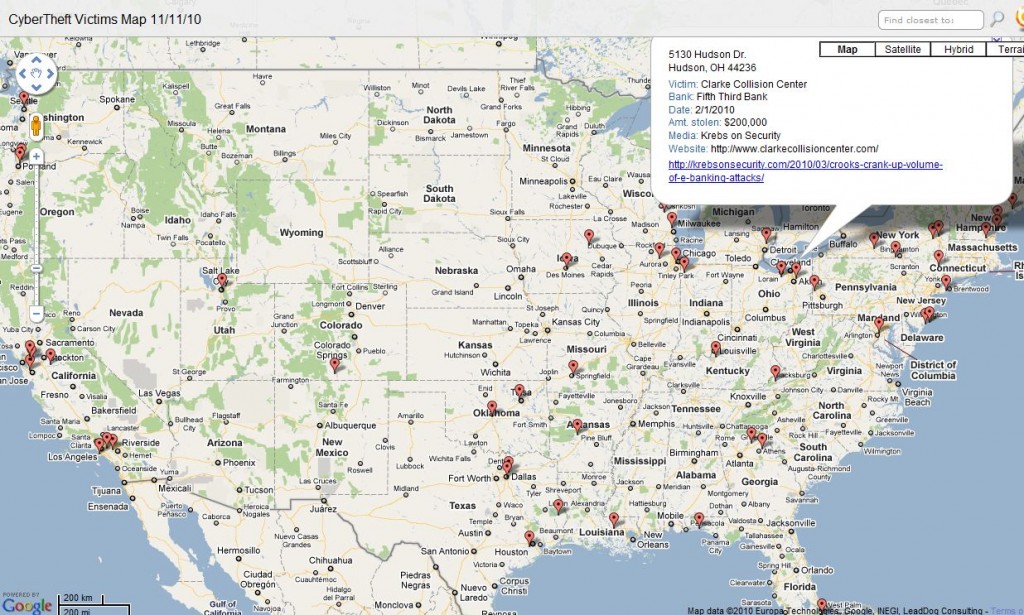
Several readers have asked to be notified if the U.S. map showing recent victims of high-dollar online banking thefts was updated. Below is a (non-interactive) screen shot of the updated, interactive map that lives here. Click the red markers to see more detail about the victim at that location, including a link to a story about the attack.


US internet hosts are linchpin of criminal botnets

From the New Scientist ...

WHILE criminal gangs in Russia and China are responsible for much of the world's cybercrime, many of the servers vital to their activities are located elsewhere. An investigation commissioned by New Scientist has highlighted how facilities provided by internet companies in the US and Europe are crucial to these gangs' activities.

Researchers at Team Cymru, a non-profit internet security company based in Burr Ridge, Illinois, delved into the world of botnets - networks of computers that are infected with malicious software. Millions of machines can be infected, and their owners are rarely aware that their computers have been compromised or are being used to send spam or steal passwords.

Several botnets have been linked to gangs based in Russia, where police have a poor record on tackling the problem. But to manage their botnets these gangs often seem to prefer to use computers, known as command-and-control (C&C) servers, in western countries. More than 40 per cent of the 1500 or so web-based C&C servers Team Cymru has tracked this year were in the US. When it comes to hosting C&C servers, "the US is significantly ahead of anyone else", says Steve Santorelli, Team Cymru's director of global outreach in San Diego.

Santorelli and his colleagues also detected a daily average of 226 C&C servers in China and 92 in Russia. But European countries not usually linked with cybercrime were in a similar range, with an average of 120 C&C servers based in Germany and 64 in the Netherlands.

Internet hosts in western countries appeal to criminals for the same reasons that regular computer users like them, says Santorelli: the machines are extremely reliable and enjoy high-bandwidth connections. Team Cymru's research did not identify which companies are hosting botnet servers, but Santorelli says the list would include well-known service providers.

The use of US-based C&C servers to control botnets is a source of frustration to security specialists, who have long been aware of the problem. It is happening even though most hosting companies shut down C&C servers as soon as they receive details of botnet activity from law enforcement agencies and security firms. "When we see an AT&T address serving as a botnet control point, we take it very seriously," says Michael Singer, an executive director at AT&T.

Despite these efforts, the criminals can quickly re-establish control by setting up a new C&C server with a different company, often using falsified registration information and stolen credit card details.

Hosting companies deal with botnets on a voluntary basis at present. They might be more vigilant if required to act by law, but that would create its own regulatory problems, Santorelli says. "The cops don't run or govern the internet after all, and neither do they want to," he says. For legal controls to work, it would be necessary to define who has the authority to decide whether a server is part of a botnet, and how requests from authorities abroad are dealt with.

Jeffrey Carr of security firm Taia Global, based in Washington DC, says that some less well-known providers have been warned about botnet activity on many occasions, but drag their heels when asked to shut down the criminals' servers.

The problem arises partly because web hosting can be a big earner for some firms. "They're generating millions of dollars in income," says Carr. Improvements in security, such as requiring service providers to verify the details of people who rent server facilities, could well hurt these firms' bottom line.

Sunday, October 31, 2010

Avalanche Gang: The Ultimate Bank Robbers?

From ZDNet ...

This time last year it was being reported that the Avalanche Gang was responsible for around a two thirds of all phishing attacks on the Internet. But Avalanche, described at the time as being "one of the most sophisticated and damaging on the Internet" by the Anti-Phishing Working Group (APWG) was only responsible for a paltry four conventional phishing attacks during the month of July 2010. Which you might think is good news, and it would be were it not for the fact that the Avalanche Gang has not hung up its spurs and given up cyber crime.

At the tail end of last year ZDNet UK reported that the Avalanche Gang, named after the botnet it employs, was collaborating with the people behind the Zeus botnet. Back then, in December 2009, Vincent Hanna who was employed as an investigator for the Spamhaus Project told ZDNet UK that the gangs behind Avalanche and Zeus were using each other's infrastructure on a purely commercial basis: "We see that the same viruses are emitting mails that benefit [the] different groups, either through spammed URLs or attached malware."

Fast forward to now, and it looks like the Avalanche Gang has completed its transition from conventional phishing and spam outfit to the world's biggest bank robbers. According to the latest APWG research, Avalanche has "moved from using conventional phishing to massively propagating stealthy password-stealing crimeware that does not require user cooperation to surrender financial account credentials."

The Avalanche Gang has been slowly ramping up a concerted campaign of crimeware propagation in order to con victims into getting infected by Zeus. Well, I say slowly, but everything is relative: according to the APWG research Avalanche has been sending billions of faked messages from tax authorities, false alerts/updates purporting to be from popular social networking sites, and other scams designed to deliver marks to drive-by download sites.

I have heard nothing to suggest that there is any evidence that Operation Trident Breach, an international effort involving the FBI and the Metropolitan Police as well as other law enforcement agencies around the world and which has so far led to the arrest of 150 people involved with the Zeus operation, has actually led to any arrests of Avalanche Gang members.

As Rod Rasmussen, co-author of the APWG research report, says: "Their spamming and other activities to target victims continues at high levels, implying they are finding malware distribution a more effective and profitable tactic than traditional phishing." With Zeus being responsible for hundreds of millions of pounds worth of theft to date, and no Avalanche arrests making the headlines, that would make the Avalanche Gang the most successful bank robbers in history.

Bredolab botnet shut down

From F-Secure ...

The Dutch National Crime Squad has announced a major takedown. The people behind the botnet have not been caught, but the servers (hosted in LeaseWeb IP space) have been taken over, effectively shutting down the botnet.

Bredolab is a large family of complicated, polymorphic trojans. They have been distributed via drive-by-downloads and email. Bredolab is known to be connected to email spam campaigns and rogue security products. And the size of the botnet was massive: over 30 million infected computers and close to 150 command & control servers.

Interestingly, the crime squad has announced that they will be sending a warning to infected PCs: "Users of computers with viruses from this network will receive a notice of at the time of next login with information on the degree of infection."

So they will probably use the existing botnet infrastructure to send a program to all infected machines, showing them a warning.

This is rarely done because running code on somebody else's computer might be seen as "unauthorized use", possibly making it illegal - although the intentions are obviously good.

Here's a video with more information (Severe warning! It is in Dutch).

Updated to add: The Dutch police is redirecting Bredolab-infected computers to this help page.

Updated to add: A 27-year old man has been arrested in Armenia. He is under investigation for being one of the operators behind Bredolab.

Wednesday, October 27, 2010

Good news, of a kind, from a dark world

From Josephn Menn at BoingBoing ...

As a fan of BoingBoing dating from a decade ago, when it was delivered on horseback, I wanted to share something positive with fellow readers in my first guest post. Unfortunately, the thing I've been most passionate about in my reporting and writing since 1999--cybercrime and tech security--doesn't lend itself to much that's happy. What I'm offering today is a compromise. It was good news to me personally, and it will be good news to those of you who have my read my book, Fatal System Error. For the rest of you, it won't be pleasant, and I'm sorry about that.

On Friday, I got a Skype message from a longtime source of mine: "My friend got his daughter back." We spoke on Sunday, and I will tell you what I can from that talk. To begin with, though, my source uses the fake name Jart Armin of HostExploit.

Like the people who work at Spamhaus, Jart is one of those people dedicated to tracking the worst cyber gangs who works in anonymity in order to protect himself. I don't like quoting people I can't name, but I did so in the book with Jart because he has done important research and because he is entirely right to be afraid of the people he has been tracking.

To explain that in the book, I briefly told the story of a colleague of Jart's who was investigating mob activity in St. Petersburg, Russia. The colleague made the mistake of working with the local police. Before he finished his assignment, the man's teenage daughter was kidnapped from her Western country, and the investigator got a message that if he dropped the case, the rest of his children might be okay.

That was five years ago. I had to leave the story hanging in the book because there had been no closure. A couple of weeks ago, the man got a new message. His daughter was in Kazakhstan, and he could have her back as long as he agreed not to look into certain of the gang's activities. One factor in the change of heart was the additional attention that Fatal System Error brought to the mob. The family has been reunited, though the young woman is not the same as she was. She was fed drugs and used to service men. A grim story, but at least it has an ending now, and I wanted to update those who knew the first part.

There are many reasons why cybercrime is as bad as it is, and getting much worse. One of them is lack of awareness of how dangerous and well-connected the gangs are. The most serious identity thieves and fraudsters are not isolated teenage script kiddies. They are mobsters who kill people, and worse, though those stories are seldom told. Folks need to know just how bad they are, every bit as much as they need to know the stories of the heroes who are risking their lives to stop them.


For those interested I strongly recommend you read Menn's book Fatal System Error.

Sunday, October 24, 2010

M&A in the Underground Economy

From Krebs on Security ...

Leading malware developers within the cyber crime community have conspired to terminate development of the infamous ZeuS banking Trojan and to merge its code base with that of the up-and-coming SpyEye Trojan, new evidence suggests. The move appears to be aimed at building a superior e-banking threat whose sale is restricted to a more exclusive and well-heeled breed of cyber crook.

Underground forums are abuzz with rumors that the ZeuS author — a Russian hacker variously known by the monikers “Slavik” and “Monstr” — is no longer planning to maintain the original commercial crimeware kit.

According to numerous hacker forums, the source code for ZeuS recently was transferred to the developer of the SpyEye Trojan, a rival malware maker who drew attention to himself by dubbing his creation the “ZeuS Killer.” The upstart banking Trojan author constantly claimed that his bot creation kit bested ZeuS in functionality and form (SpyEye made headlines this year when investigators discovered it automatically searched for and removed ZeuS from infected PCs before installing itself).


The rest of this post does an excellent job of describing the competitive dynamics in the underground marketplace. Read more here.

Monday, October 4, 2010

Ukraine Detains 5 Individuals Tied to $70 Million in U.S. eBanking Heists

From Krebs on Security,

Authorities in Ukraine this week detained five individuals believed to be the masterminds behind sophisticated cyber thefts that siphoned $70 million – out of an attempted $220 million — from hundreds of U.S.-based small to mid-sized businesses over the last 18 months, the FBI said Friday.

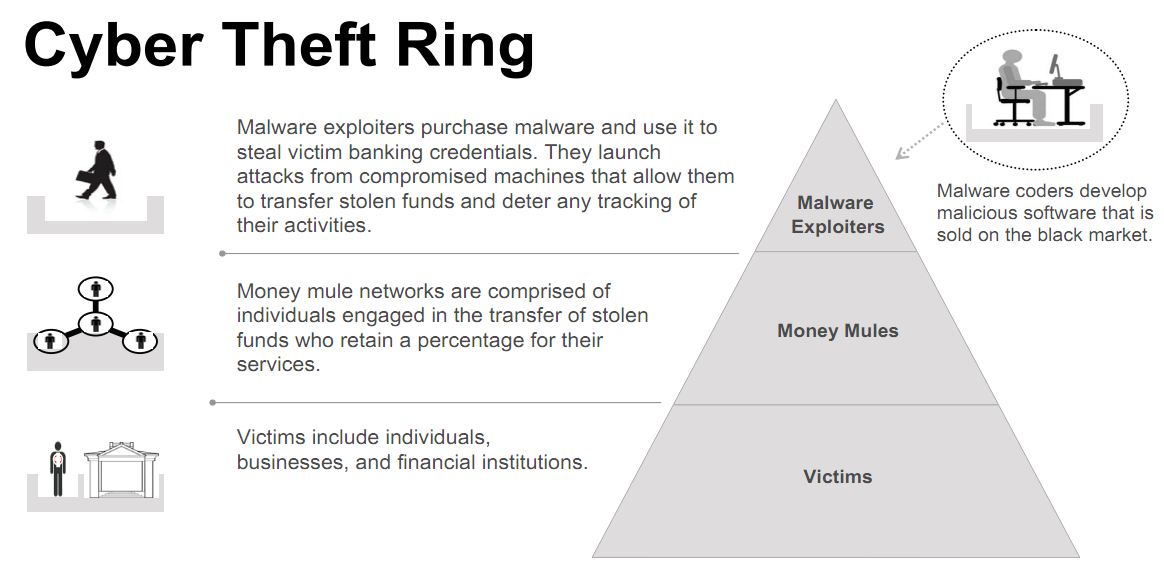
At a press briefing on “Operation Trident Breach,” FBI officials described the Ukrainian suspects as the “coders and exploiters” behind a series of online banking heists that have led to an increasing number of disputes and lawsuits between U.S. banks and the victim businesses that are usually left holding the bag.

The FBI said five individuals detained by the Security Service of Ukraine (SBU) on Sept. 30 were members of a gang responsible for creating specialized versions of the password-stealing ZeuS banking Trojan and deploying the malware in e-mails targeted at small to mid-sized businesses.

Investigators say the Ukrainian gang used the software to break into computers belonging to at least 390 U.S. companies, transferring victim funds to more than 3,500 so-called “money mules,” individuals in the United States willingly or unwittingly recruited to receive the cash and forward it overseas to the attackers. In connection with the investigation, some 50 SBU officials also executed eight search warrants in the eastern region of Ukraine this week
.

Wednesday, September 29, 2010

FBI Drive for Encryption Backdoors Is Déjà Vu for Security Experts

From Wired Magazine via the New York Times,

The FBI now wants to require all encrypted communications systems to have back doors for surveillance, according to a New York Times report, and to the nation’s top crypto experts it sounds like a battle they’ve fought before.

Back in the 1990s, in what’s remembered as the crypto wars, the FBI and NSA argued that national security would be endangered if they did not have a way to spy on encrypted e-mails, IMs and phone calls. After a long protracted battle, the security community prevailed after mustering detailed technical studies and research that concluded that national security was actually strengthened by wide use of encryption to secure computers and sensitive business and government communications.

Now the FBI is proposing a similar requirement that would require online service providers, perhaps even software makers, to only offer encrypted communication unless the companies have a way to unlock the communications.

In the New York Times story that unveiled the drive, the FBI cited a case where a mobster was using encrypted communication, and the FBI had to sneak into his office to plant a bug. One of the named problems was RIM, the maker of BlackBerrys, which provides encrypted e-mail communications for companies and governments, and which has come under pressure from India and the United Arab Emirates to locate its severs in its countries.

According to the proposal, any company doing business in the States could not create an encrypted communication system without having a way for the government to order the company to decrypt it, and those who currently do offer that service would have to re-tool it. It’s the equivalent of outlawing whispering in real life.


Read the full article here.

Sunday, September 26, 2010

DDOS Botnets in Action

The Shadowserver Foundation is an all volunteer group of security researchers that monitor and report on online malicious activity. They occasionally blog about some of there more interesting findings. A found a recent post about DDOS botnets particularly interesting.

One of the uses of botnets that I find particularly interesting are Distributed Denial of Service(DDoS) attacks. I spend a fair amount of time tracking the various botnet related attacks that Shadowserver sees, especially when the list of victims is of fairly high profile. I've been watching a DDoS group that has been attacking a wide variety of victims in several different countries. This groups uses the BlackEnergy botnet to carry out its attacks.


The rest of the post can be found here.

Saturday, September 25, 2010

ATM Skimmers in Action

From Wired Magazine,

Authorities in Europe have seized a nice video recorded by a group of carders showing the criminals installing a skimming device and hidden camera at an ATM in the United Kingdom to steal customer PINs. Filmed from the hidden pinhole camera itself, installed above the ATM, the video shows how easy it is to capture the PINs as customers enter them on the keypad. But a few wily customers, who are wise to the carders’ tricks, manage to thwart their scheme by shielding the keypad as they type in their number.


Monday, April 26, 2010

Charting Cybercrime

Brian Krebs pointed me to this Google mashup created by Aaron Jacobson of Authentify. It uses media reports to chart online banking heists. As you can see the damage has been widespread and costly. Krebs provides his thoughts on the mashup here.

View Cybertheft Victims in a larger map

Friday, April 16, 2010

Almost all Fortune 500 companies show Zeus botnet activity

From Ars Technica ...
Up to 88% of Fortune 500 companies may have been affected by the Zeus trojan, according to research by RSA's FraudAction Anti-Trojan division, part of EMC. The trojan installs keystroke loggers to steal login credentials to banking, social networking, and e-mail accounts.

The botnet was first identified in 2007 and is still around today. The malware tends to be difficult to detect and remove, and several million machines worldwide are believed to be infected. The Zeus server-side components, used to collect the stolen data, surprisingly mimic techniques more commonly seen in the world of commercial software; the software is licensed (with fees ranging from several hundred to a few thousand dollars), and each installation is tied to the hardware it's installed on in a system reminiscent of Microsoft's software activation. The malware itself predominantly attacks Windows XP machines, though Windows Vista and Windows 7 variants are available for sale too.
Read the full article here.

Monday, April 12, 2010

Iowa bank compromised, serving exploits

From Sunbelt Software's blog ...

Northwestern Bank Online, a bank in Iowa, was compromised.


On Friday April 9th, engineers from Sunbelt noticed that the Northwestern Bank Online site was redirecting to an exploit pack with infected vulnerable users.


Further investigation by Dancho Danchev revealed that this exploit dropped the Zeus banking trojan onto vulnerable victims machines. Zeus is a particularly nasty piece of malware. Kevin Stevens and Don Jackson from SecureWorks provide an excellent write-up on Zeus here. You can also track live Zeus infections here at the Zeus Tracker.

Sunday, April 11, 2010

Investigating a Phishing Attack

A former student noticed this strange email sent to a Georgetown University mailing address on Friday April 9, 2010. My former student noticed immediately that the email's return address was not in the Georgetown.edu domain and was instead warningalertweb@ymail.com. Ymail.com is a Yahoo! email address. Further, the email requested students reply with their university userid and passwords. Clearly this was a phishing attempt. I trust that all current and former students of this class would have immediately recognized this email scam.


As I had some spare time this weekend, I decided to investigate this amateurish attempt to steal personal information from the student body. This first thing I did was examine the headers of the email. From the GMail web client you can view the headers by clicking on the down arrow immediately to the right of the reply icon and selecting show original.


An examination of the headers revealed that the email originated from a server in South Korea with the IP address 119.70.40.101. Further, it appears the spammers utilized a hacked email account belonging to a real estate agent in Roseburg, Oregon.


According to Project Honeypot, the South Korean server has previously been used by spam harvesters and comment spammers.


While satisfied that I understood how the spammers executed their fraud, I still wanted to know more about the individual(s) attempting to steal personal information from the student body. So, I decided to respond to their phishing attempt with one of my own. I setup a fake email account and responded to the phishing attempt with phony information. I embedded my phony reply with web bugs and links back a blog that I established to act as a honeypot.

My plan was simple. The scammer would open my response email thinking that they had stolen data from an unwitting victim. As they opened my email, the web bugs would beacon back to my blog giving me the hackers IP address. Alternatively, the attacker would be dumb enough to click on the embedded links to my phony blog. In this case, it appears the hacker was dumb enough to click on the links back to the fake blog. This action revealed that the hacker was retrieving the stolen information via a computer in Hyderabad, India. It is possible that the attacker was using a proxy to retrieve his stolen data, but the fact that he clicked on the blog link in my phony email doesnt give me much confidence that this clown practices solid operation security.

Friday, April 9, 2010

Bank of America Employee Charged With Planting Malware on ATMs Read More

A Bank of America worker installed malicious software on his employer’s ATMs that allowed him to make thousands of dollars in fraudulent withdrawals, all without leaving a transaction record, according to federal prosecutors.

Rodney Reed Caverly, 37, was a member of the bank’s IT staff when he installed the malware. The Charlotte, North Carolina, man made fraudulent withdrawals over a seven-month period ending in October 2009, according to prosecutors, who’ve charged him with one count of computer fraud.
The Wired piece continues with more detail
The charges were filed the same day that credit card company Visa warned the banking industry that Eastern European ATM malware recently showed up in America for the first time.

That code, initially spotted last year on some 20 ATMs in Russia and Ukraine, was designed primarily to capture PINs and bank card magstripe data, but also allowed thieves to instruct the machine to eject whatever cash was still in it. At the time, security firm Trustwave warned that the malware was likely headed for ATMs in the United States.

At least 16 versions of the East European malware have been found so far and were designed to attack ATMs made by Diebold and NCR, according to the April 1 Visa alert.

There is no information tying the malware found in Russia with the malware allegedly used by Caverly. Bank of America did not immediately respond to a call for comment about the case, but told the Associated Press that the bank discovered the thefts internally. Caverly’s attorney did not return a call.

Nick Percoco, vice president and head of Trustwave’s SpiderLabs Incident Response Team, said the malware does sound like it could be the malware found in East Europe or a version of it.

“[Caverly] could have obtained a copy of that and modified it for his own use,” he told Threat Level. “But the ability to dispense cash without recording activity — that was definitely a feature of the East European malware.”
On a related note, police in Alexandria, Virginia, a mere twenty minutes from campus, reported the discovery of an ATM skimming device. According the Alexandria Police Department, on Sunday February 28, 2010 an ATM skimming device was discovered at the Wachovia Bank at 3624 King Street. The Police noted, "an ATM technician working on the machine found the skimming device. The engineer took photos of the device and went inside the bank to notify the bank’s security office. When he returned a few minutes later, the device had been removed. Several customers have come forward to report fraudulent charges on their bank cards with current losses estimated at over $60,000."


Brian Krebs from Krebsonsecurity.com has extensively covered how criminals have used hardware and software tools to steal ATM card information and pin codes. Check out his reporting here and here.