
Is this an overstatement?
Leading malware developers within the cyber crime community have conspired to terminate development of the infamous ZeuS banking Trojan and to merge its code base with that of the up-and-coming SpyEye Trojan, new evidence suggests. The move appears to be aimed at building a superior e-banking threat whose sale is restricted to a more exclusive and well-heeled breed of cyber crook.
Underground forums are abuzz with rumors that the ZeuS author — a Russian hacker variously known by the monikers “Slavik” and “Monstr” — is no longer planning to maintain the original commercial crimeware kit.
According to numerous hacker forums, the source code for ZeuS recently was transferred to the developer of the SpyEye Trojan, a rival malware maker who drew attention to himself by dubbing his creation the “ZeuS Killer.” The upstart banking Trojan author constantly claimed that his bot creation kit bested ZeuS in functionality and form (SpyEye made headlines this year when investigators discovered it automatically searched for and removed ZeuS from infected PCs before installing itself).
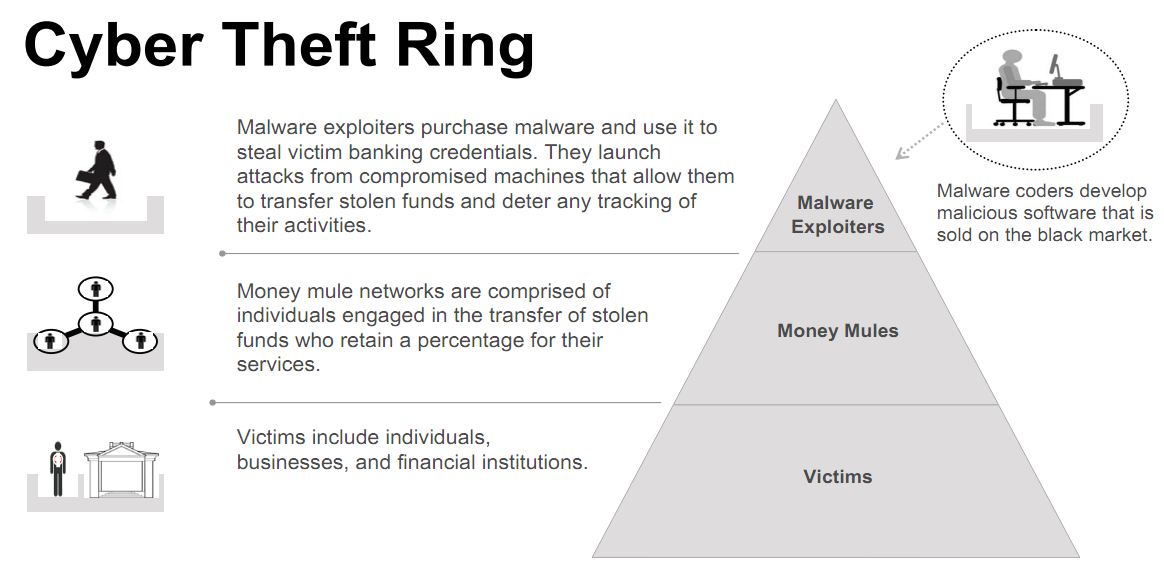
Authorities in Ukraine this week detained five individuals believed to be the masterminds behind sophisticated cyber thefts that siphoned $70 million – out of an attempted $220 million — from hundreds of U.S.-based small to mid-sized businesses over the last 18 months, the FBI said Friday..
At a press briefing on “Operation Trident Breach,” FBI officials described the Ukrainian suspects as the “coders and exploiters” behind a series of online banking heists that have led to an increasing number of disputes and lawsuits between U.S. banks and the victim businesses that are usually left holding the bag.
The FBI said five individuals detained by the Security Service of Ukraine (SBU) on Sept. 30 were members of a gang responsible for creating specialized versions of the password-stealing ZeuS banking Trojan and deploying the malware in e-mails targeted at small to mid-sized businesses.
Investigators say the Ukrainian gang used the software to break into computers belonging to at least 390 U.S. companies, transferring victim funds to more than 3,500 so-called “money mules,” individuals in the United States willingly or unwittingly recruited to receive the cash and forward it overseas to the attackers. In connection with the investigation, some 50 SBU officials also executed eight search warrants in the eastern region of Ukraine this week
New clues released this week show a possible link between Israel and sophisticated malware targeting industrial control systems in critical infrastructure systems, such as nuclear plants and oil pipelines.
Late Thursday, security firm Symantec released a detailed paper with analysis of the headline-making code (.pdf), which reveals two clues in the Stuxnet malware that adds to speculation that Israel may have authored the code to target Iran.
Or, they could simply be red herrings planted in the code by programmers to point suspicion at Israel and away from other possible suspects.
The malware, called Stuxnet, appears to be the first to effectively attack critical infrastructure and in a manner that produces physical results, although there’s no proof yet any real-world damage has been done by it. The malware’s sophistication and infection of thousands of machines in Iran has led some to speculate that the U.S. or Israeli government built the code to take out Iran’s nuclear program.

The results of a study conducted by researchers from Duke University, Penn State University, and Intel Labs have revealed that a significant number of popular Android applications transmit private user data to advertising networks without explicitly asking or informing the user. The researchers developed a piece of software called TaintDroid that uses dynamic taint analysis to detect and report when applications are sending potentially sensitive information to remote servers.
They used TaintDroid to test 30 popular free Android applications selected at random from the Android market and found that half were sending private information to advertising servers, including the user's location and phone number. In some cases, they found that applications were relaying GPS coordinates to remote advertising network servers as frequently as every 30 seconds, even when not displaying advertisements. These findings raise concern about the extent to which mobile platforms can insulate users from unwanted invasions of privacy.
The FBI now wants to require all encrypted communications systems to have back doors for surveillance, according to a New York Times report, and to the nation’s top crypto experts it sounds like a battle they’ve fought before.
Back in the 1990s, in what’s remembered as the crypto wars, the FBI and NSA argued that national security would be endangered if they did not have a way to spy on encrypted e-mails, IMs and phone calls. After a long protracted battle, the security community prevailed after mustering detailed technical studies and research that concluded that national security was actually strengthened by wide use of encryption to secure computers and sensitive business and government communications.
Now the FBI is proposing a similar requirement that would require online service providers, perhaps even software makers, to only offer encrypted communication unless the companies have a way to unlock the communications.
In the New York Times story that unveiled the drive, the FBI cited a case where a mobster was using encrypted communication, and the FBI had to sneak into his office to plant a bug. One of the named problems was RIM, the maker of BlackBerrys, which provides encrypted e-mail communications for companies and governments, and which has come under pressure from India and the United Arab Emirates to locate its severs in its countries.
According to the proposal, any company doing business in the States could not create an encrypted communication system without having a way for the government to order the company to decrypt it, and those who currently do offer that service would have to re-tool it. It’s the equivalent of outlawing whispering in real life.


